
The relentless Western Australian sun is a hallmark of life in Capel, offering beautiful summer days but also presenting unique challenges for homeowners. While we focus on air conditioning and insulation, the most critical defense against the local heat—the residential electrical system—is often overlooked. Your switchboard acts as the central nervous system of your home’s power, managing the flow to every appliance. However, many older homes in the region are still operating on outdated fuse boxes that were never designed to handle the electrical demands of 2026 living, especially when temperatures soar and our reliance on power skyrockets.
Ensuring your home’s electrical core is robust is not just an efficiency choice; it is a critical safety imperative. Undergoing a professional switchboard upgrade is the single most effective way to prevent electrical fires caused by overloading. If you’re curious about broader changes coming to the sector, exploring Electrical Services provides excellent context on upcoming innovations. However, the most immediate and impactful safety improvement you can make right now is a switchboard upgrade to replace an obsolete and dangerous system.
The Hidden Risks in Older Capel Homes
It’s easy to ignore what we can’t see. The wiring and components hidden inside your electrical panel are often “out of sight, out of mind” until something goes wrong. In Capel, where many properties reflect the town’s charming history, the underlying electrical infrastructure frequently dates back several decades.
Outdated Fuse Boxes vs. Modern Circuit Breakers
The most significant distinction between an old system and a new one is the technology used to stop an electrical overload before it turns into a fire.
The Danger of Old Ceramic Fuses
Older homes often still use ceramic fuses. These devices work by having a thin wire that melts when too much current flows through it, breaking the circuit. The problem is not the theory, but the practice. If a fuse blows, it must be manually rewired. Homeowners, frustrated by frequent breaks, might incorrectly use a thicker wire than specified. This “fix” allows dangerous levels of current to flow, which heats the wiring instead of the fuse, significantly increasing the risk of an electrical fire.
Limitations of First-Generation Circuit Breakers
Even if your switchboard doesn’t have fuses, it might still have early-generation circuit breakers. While better than fuses, these older mechanical switches are slower to react than modern equivalents and often wear out over time. Furthermore, they lack the sophisticated protection required by current Australian Standards, particularly the comprehensive use of RCDs.
Absence of Vital Safety Devices (RCDs)
The biggest advancement in household electrical safety over the last 30 years is the invention of the Residual Current Device (RCD), commonly known as a safety switch.
The RCD Revolution: From Optional to Mandatory
RCDs work by constantly monitoring the current flowing in and out of a circuit. If they detect a difference indicating electricity is leaking to Earth (potentially through a person getting an electric shock)—they shut off the power in milliseconds. This is incredibly fast, significantly reducing the risk of death by electrocution.
Why Older Circuit Breakers Fail to Protect
Standard circuit breakers are designed to protect the wires from catching fire by shutting down during a short circuit. They are not designed to protect people from electrocution. If a person interacts with a faulty appliance, the leakage might not be enough to trip an old circuit breaker, but it is more than enough to be fatal. Only a modern RCD provides the lifesaving protection that older systems completely lack.
The Western Australian Factor: Rising Heat and Modern Demands
The climate and the way we use energy have fundamentally changed since many of Capel’s older switchboards were installed. Today’s homes are power-hungry, and our environment is getting harsher.
Extreme Heat and Electrical Load: A Dangerous Mix
WA is experiencing hotter, longer summers. The response to this is universal: everyone turns on their air conditioner at the same time.
The “A/C Surge” and Power Consumption Peaks
When a whole street uses air conditioners simultaneously on a 40°C day, the electrical grid—and your home’s entry point—experiences a massive, prolonged power demand. This is the moment when an aging switchboard is most vulnerable. A system designed decades ago simply was not built with the anticipation of several high-powered inverter air conditioners, pool pumps, and modern appliances all running at peak load on a superheated summer day.
How Heat Increases Risk of Fire
Electrical insulation and terminal components become brittle with age and extreme heat cycles. Under heavy load, marginal connections can become very hot. If this heat occurs near aged insulation or plastic housings, it can initiate combustion, leading to a major electrical fire that can quickly spread to the house.
Modern Power Usage vs. Legacy Capacity
We are simply living differently now. Modern technology requires more power and more reliable power than ever before. For official guidance on how these standards are monitored, you can refer to the Western Australian Department of Energy, Mines, Industry Regulation and Safety.
Understanding the Increased Wattage We Draw
Consider a typical family in Capel today. They likely have:
- Ducted or multiple split-system air conditioning.
- Electric heat-pump or boosted hot water systems.
- Induction cooktops and high-speed electric ovens.
- Multiple computers, home offices, and EV charging stations.
Specific Loads: Induction Cooktops and EV Charging
Newer technologies place unique stressors on a system. For instance, an induction cooktop can pull a sudden, massive amount of power. The growing adoption of Electric Vehicles (EVs) means homes are now adding what is essentially a small industrial-grade load for several hours. If your switchboard is not ready, adding these loads is a recipe for failure.
The Solution: What a Switchboard Upgrade Involves
An upgrade is a comprehensive, certified electrical procedure that fundamentally improves the heart of your home’s power distribution.
Detailed Comparison of Systems
The following table highlights the critical differences between dangerous legacy systems and modern, compliant switchboards.
| Feature | Legacy System (Old Fuse Box) | Modern Upgraded Switchboard |
| Main Protection | Rewireable Ceramic Fuses | Modern Circuit Breakers (MCB) |
| Shock Protection | Little to No RCD Protection | Full RCD/RCBO protection on ALL circuits |
| Overload Protection | Slow and Unreliable | Fast, precise mechanical tripping |
| Fire Safety | High risk due to heat and aging | Non-combustible enclosures and cool operation |
| Future Readiness | Not compatible with Solar/EV | Fully ready for Solar, EV, and Smart Home |
The Professional Installation Process
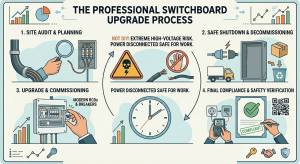
It’s crucial to state that a switchboard upgrade is NOT a DIY task. It involves working with high-voltage mains power where the risks of a fatal error are extreme.
Pre-Upgrade Inspection and Site Assessment
A licensed electrician performs a comprehensive audit of your home’s existing electrical system, measuring the incoming main power cable and checking the grounding system.
Decommissioning and Professional Removal
Your electrician coordinates a temporary power disconnection with Western Power to safely remove the old enclosure and all obsolete internal wiring.
Mandatory Testing and Certification
Once installed, your electrician must perform mandatory tests for fault loops and RCD trip times. A formal Electrical Safety Certificate is then issued—this is your legal proof that your installation is compliant and safe.
Integration with Smart Home Technology and Energy Monitoring
As we move further into 2026, the “dumb” switchboard is becoming a thing of the past. A modern upgrade allows you to transition into a smart energy ecosystem that provides more than just safety—it provides data.
The Rise of Smart Circuit Breakers
Modern switchboard enclosures now have the physical space to accommodate smart modules. These devices can track the energy consumption of individual appliances, such as your air conditioner or pool pump, in real-time. By identifying which devices are drawing the most power during peak heat periods, you can adjust your habits to lower your Western Power utility bills.
Remote Power Management and Notifications
Some high-end switchboard upgrades now include Wi-Fi-connected gateways. If a circuit trips while you are away from home—perhaps cutting power to your freezer or security system—you can receive an instant notification on your smartphone. This level of oversight was impossible with old ceramic fuses and provides an extra layer of security for Capel families who travel or work long hours.
Impact on Property Valuation and Pre-Purchase Inspections
In the competitive Western Australian real estate market, the condition of a home’s electrical system can be a major “make or break” point during a sale.
Why Building Inspectors Flag Old Boards
During a pre-purchase building inspection in Capel, the electrical panel is one of the first things checked. An outdated board is often listed as a “Major Defect” or a “Safety Hazard” in the final report. This can give potential buyers leverage to negotiate thousands of dollars off your asking price, or worse, cause the sale to fall through entirely if the buyer’s bank refuses to finance an “electrically unsafe” property.
The “Certificate of Compliance” Advantage
Having a modern switchboard with a valid Electrical Safety Certificate provides a “paper trail” of quality maintenance. It signals to buyers that the home has been cared for and is ready for immediate move-in without the need for costly renovations. It is often more cost-effective to upgrade the board before listing the property than to lose a sale over a $1,500 electrical issue.
Specific RCD Testing and Maintenance Requirements in WA
Installing a modern switchboard is the first step, but Western Australian safety guidelines also emphasize the ongoing maintenance of these lifesaving devices.
The “Push-Button” Test for Homeowners
Every RCD is equipped with a “Test” button. WA safety authorities recommend that homeowners test their RCDs every three months. When you press this button, the RCD should trip and cut power instantly. This mechanical test ensures the internal components haven’t become “sticky” or seized due to the dust and humidity often found in regional areas like Capel.
Professional Testing Intervals
While the homeowner test is vital, it doesn’t check the actual “trip time” in milliseconds. A professional electrician uses specialized equipment to ensure the device is cutting power within the required 300 milliseconds. Including a professional check-up as part of your regular home maintenance schedule ensures that when a real fault occurs—like a frayed cord on a pedestal fan during a heatwave—the system will act exactly as designed to save a life.
Conclusion
The unrelenting heat of a Western Australian summer is a thermal stress test for your electrical system. As your home’s power-handling demands increase, an outdated fuse box becomes a significant liability. Switchboard upgrades are the single most important action you can take to prevent electrical fires and ensure that everyone in your home is protected from the risk of electrocution. Ignoring this issue means you are counting on luck rather than engineered safety.
Your family’s safety and your home’s integrity are not worth the gamble. Don’t wait for a dangerous fault or the sweltering peak of summer to find out your system is inadequate. The peace of mind that comes from a certified, modern electrical core is invaluable. We are your local Capel specialists in delivering safe, compliant, and efficient energy solutions.
Contact us today to get a quote and schedule a comprehensive inspection, and take the first critical step toward future-proofing and fire-proofing your home.
Frequently Asked Questions
How much does a typical modern switchboard upgrade cost in WA?
In 2026, a standard residential switchboard upgrade in Western Australia typically ranges from $1,200 to $2,500. This varies based on the number of circuits and if your main power cable (consumer mains) also needs an upgrade.
How long will my power be off during the upgrade?
A professional switchboard upgrade usually takes between 4 to 8 hours. Your power will be entirely disconnected during this time, so we recommend planning ahead for food storage and electronic devices.
Do I need a switchboard upgrade to install Solar Panels?
Yes. Under current WA regulations, most solar installations require the switchboard to be brought up to modern standards, specifically ensuring RCD protection is present for the new components.
What is the difference between an RCD and a circuit breaker?
A circuit breaker protects your appliances and wiring from burning out due to overloads. An RCD (Safety Switch) is designed specifically to protect people from lethal electric shocks by cutting power instantly.
Are ceramic fuses illegal in Capel homes?
While not “illegal” to possess, it is against Australian Wiring Rules to install or repair them. If a ceramic fuse base is damaged, a licensed electrician is legally required to replace it with a modern circuit breaker.
Can a switchboard upgrade lower my insurance premiums?
Many insurance companies look favourably on modernized electrical systems. An upgrade reduces the risk of fire claims, and having a valid Safety Certificate can sometimes help in negotiating better coverage or avoiding claim denials.