
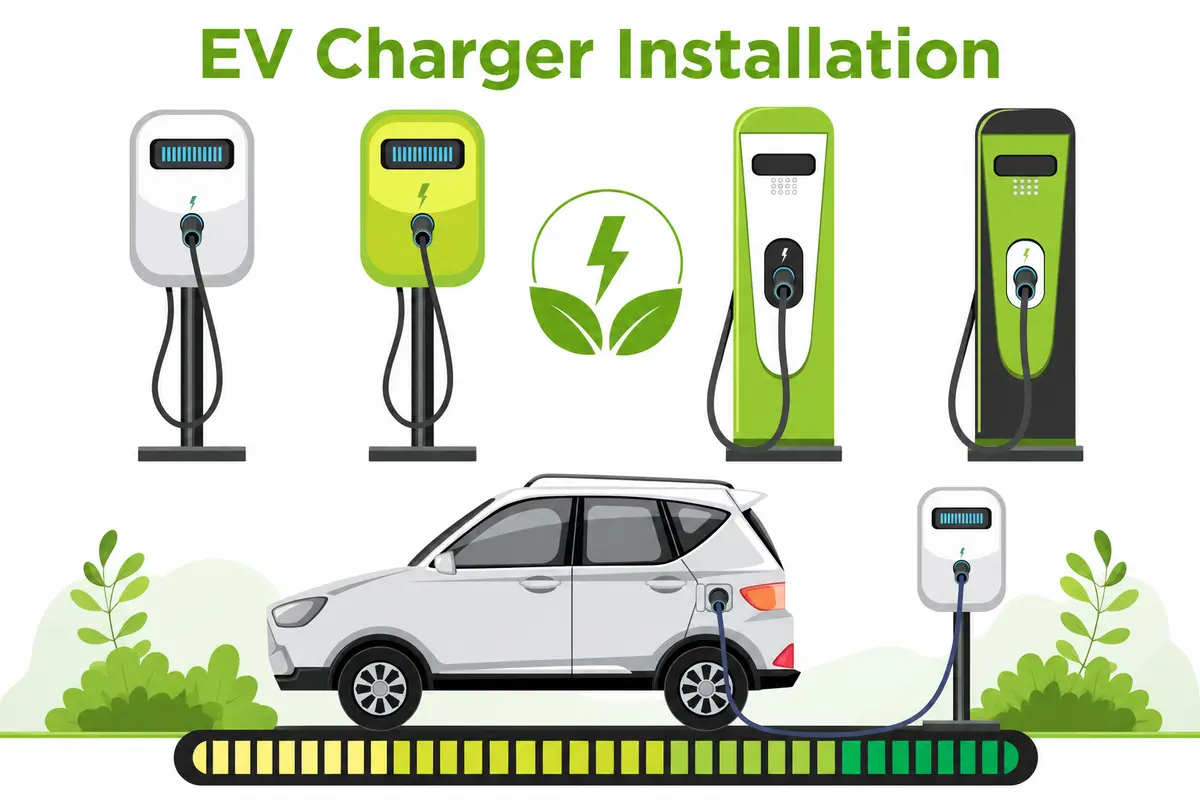
EVs aren’t a rare sight anymore around Capel or across the South West. Whether it’s the daily school run or weekend coastal trips down to Margs, plenty of locals are switching to cleaner transport. The main headache for new owners, though, comes down to painfully slow charging speeds and spiking Synergy power bills.
A standard wall socket may technically charge an electric vehicle, but it often feels like filling a swimming pool with a garden hose. Charging times can stretch for many hours, and energy management becomes less efficient. That is where EV Charger Installation changes the game.
Getting a dedicated wallbox set up properly gives you rapid charging, better home safety, total power tracking, and massive long-term savings. Modern smart units talk directly with your home energy setup, moving your main power draw to cheap off-peak hours or sinking your excess solar straight into the car, making a professional EV Charger Installation a smart move for any local driver.
This quick breakdown covers the realities of a solid EV Charger Installation, focusing on real-world costs, trade requirements, solar hookups, and how smart tech helps regional households charge their cars faster without blowing out the family budget.
Hidden Electrical Constraints Found During Site Visits
Properties across the region present a surprising variety of electrical setups. Older homes often contain equipment that was never designed to support sustained charging loads. Newer homes are not automatically exempt either. Large air-conditioning systems, pools, and growing appliance demands can already place significant pressure on household capacity before a home EV charger installation is even added.
Many enquiries related to EV charger installation South West WA begin with a homeowner requesting a specific charger model. After inspection, the discussion shifts towards available electrical capacity. That change catches people off guard. The charger itself might be perfectly suitable, yet the existing infrastructure may not be ready to support it without modification.
Homeowners constantly underestimate how much the physical cable run matters. Massive distances mean extra heavy-duty copper and more hours on the job. Tight ceiling spaces, double-brick walls, and unattached garages add real structural headaches. A high-quality EV Charger Installation deals with these local site realities instead of relying on a generic blueprint.
Standard vs Smart Chargers
| Charging Method | Typical Charging Speed | Estimated Full Charge Time |
| Standard Power Outlet | Slow | 20–40 Hours |
| Basic Dedicated Charger | Moderate | 8–12 Hours |
| Level 2 Smart Charger | Fast | 4–8 Hours |
| Advanced Smart Charger | Very Fast | 2–6 Hours* |
Cost Expectations Versus Real Installation Conditions
Conversations about price often start with numbers found online. The difficulty is that generic estimates rarely reflect actual site conditions. A basic electric vehicle charger installation can remain relatively affordable, but as any comprehensive Home EV Charger Guide will highlight, projects become more expensive when electrical upgrades, long cable runs, or integration requirements enter the equation.
We see the same trap every week. People shop online for the cheapest hardware box but completely ignore the actual installation variables. The unit itself is only half the battle. Trade labour, Western Power compliance, safety switches, and main board upgrades drive up the final quote, which is why budgeting solely for the box leaves you short during an EV Charger Installation.
We see the same trap every week. People shop online for the cheapest hardware box but completely ignore the actual installation variables. The unit itself is only half the battle. Trade labour, Western Power compliance, safety switches, and main board upgrades drive up the final quote. Budgeting solely for the box leaves you short. We see the same trap every week. People shop online for the cheapest hardware box but completely ignore the actual installation variables.
The unit itself is only half the battle. Trade labour, Western Power compliance, safety switches, and main board upgrades drive up the final quote. Budgeting solely for the box leaves you short. The projects that deliver the strongest long-term value are not always the cheapest. A charger selected purely on upfront price may lack flexibility or future compatibility.
Spending slightly more initially on a professional EV Charger Installation can prevent replacement costs later. Practical decisions usually sit somewhere between premium features and budget-driven compromises.
When an EV Charger Switchboard Upgrade Is Necessary
An EV charger switchboard upgrade may be required when:
- Existing switchboards are outdated
- Circuit protection is insufficient
- Additional capacity is needed
- Solar integration is planned
- Multiple chargers may be installed later
Choosing Charging Speeds That Match Actual Usage
Everyone hyper-focuses on maximum kilowatts because it’s an easy number to brag about. Fast speeds look great on a spec sheet, but your actual driving habits tell a different story. Most regional properties don’t even need the absolute maximum output, making a tailored EV Charger Installation focused on how far you drive daily matter way more than raw charger size.
Interest in Level 2 EV charger installation has increased because it strikes a balance between practicality and performance. Most households find it comfortably handles daily charging needs without introducing unnecessary infrastructure demands. Higher-capacity systems certainly have a place, though they are not automatically the most sensible choice.
A poorly matched charger can create inefficiencies. Some owners purchase larger systems expecting future benefits that never materialize. Others choose smaller units only to upgrade later. A thoughtful EV Charger Installation considers vehicle usage, household energy consumption, and future plans instead of focusing solely on advertised charging rates.
Balancing Smart Features Against Long-Term Reliability
Charging tech has moved fast over the last couple of years. The latest units give you automated timers, app tracking, and home automation links. While having that data is handy for tech-minded owners, half of these flashy digital features rarely get used once the novelty wears off after a month, proving that a reliable EV Charger Installation is more about core functionality than unnecessary gimmicks.
Local interest in an automated, smart EV charger installation is booming because people want to dodge high peak-rate tariffs. Setting up smart schedules to charge at midnight genuinely slashes your running costs and optimizes efficiency. The savings are completely real, but an app won’t magically make your electric bill disappear entirely.
Anyone hunting for a qualified EV charger electrician in Capel wants to know if high-end smart features are worth the extra cash. It comes down to your personal routine. Some blokes love staring at energy graphs every afternoon, while others just want to plug the lead in and walk away. Bulletproof hardware reliability beats buggy app features every single time, making a dependable EV Charger Installation the smartest approach for long-term peace of mind.
Solar Integration Decisions With Real Financial Tradeoffs
Sinking raw solar power straight into an EV sounds like a no-brainer on paper. You use your own free roof generation and cut down your reliance on the grid. It’s a great setup, but the actual return on investment varies wildly depending on your property layout and daily driving hours, making a well-planned EV Charger Installation essential to truly maximizing those solar savings.
Planning a dedicated solar powered EV charging system is great for cutting emissions and fuel costs. The practical hurdle is timing. If your car is parked at your workplace in Bunbury all day during peak sunlight hours, you won’t actually harvest that free solar energy unless the car is sitting in your driveway, which is why a strategic EV Charger Installation must align with your actual charging schedule to be effective.
We’re getting constant questions about complex EV charger and solar battery integration. Adding a home storage battery offers massive flexibility, but it adds serious weight to your upfront costs. Some properties get incredible results out of it, while others find the financial payback period takes way too long to justify, making a well-researched EV Charger Installation essential to determining if battery integration is right for your home.
Upgrade Requirements Many Homeowners Miss Early On
Electrical upgrades rarely feature in early planning conversations, yet they often determine project success. Existing infrastructure can become the limiting factor long before solar panel systems that power your EV for less or charger selection enter the discussion. Ignoring these limitations rarely saves money in the long run.
A proposed EV charger upgrade for home sometimes begins after a homeowner notices charging performance limitations or future vehicle plans change. Additional electrical capacity may become necessary as household energy demand grows. Planning for expansion during the initial stage often proves more economical than retrofitting later.
The need for an EV charger switchboard upgrade can surprise property owners because switchboards generally remain out of sight and out of mind. Yet this equipment forms the foundation of safe operation. A charger performs only as well as the electrical system supporting it. Upgrades may feel frustrating initially, but they frequently prevent operational issues later.
Regional Charging Trends Across South West Communities
The massive surge in EV ownership is changing the landscape right across regional WA. Charging conversations that used to happen solely in the Perth metro area are now standard talk among tradies and homeowners looking for a reliable EV Charger Installation right across smaller country towns and regional hubs in South West WA.
The massive spike in requests for an EV charger installation Busselton wide shows that drivers want their own private setup. Sure, public fast-chargers are popping up along the highway, but nothing beats the convenience and peace of mind of plugging in overnight at home. It just becomes part of your regular evening routine.
A similar pattern exists around EV charger installation Bunbury, where increasing vehicle adoption has encouraged greater investment in charging infrastructure. Local experience suggests homeowners are becoming more informed about equipment options, energy management, and long-term operating costs than they were only a few years ago.
Understanding Safety Compliance Beyond Basic Rules
Safety discussions often focus on compliance certificates and regulatory requirements. While those elements matter, practical safety extends beyond paperwork. Reliable operation depends on proper design, quality workmanship, and a realistic assessment of household electrical demands to ensure a safe and efficient EV Charger Installation.
Understanding EV charger electrical requirements involves more than identifying an available circuit. Load calculations, protection devices, cable sizing, and installation conditions all influence performance. Small oversights can create frustrating operational problems that only emerge months after installation.
Guidance around EV charger safety requirements WA exists for good reason. Electric vehicle chargers draw substantial power over extended periods. A safe installation is not necessarily the cheapest option, nor the fastest to complete. It is the one designed to perform consistently without introducing unnecessary risk.
Practical Charging Strategies That Actually Work Daily
A surprising number of charging issues stem from habits rather than equipment faults. Homeowners often focus heavily on technology- like integrating solar battery storage for smarter EV charging, while overlooking how charging fits into normal daily routines. The simplest charging strategy is frequently the most effective.
An electric vehicle home charging guide should ideally begin with understanding driving behaviour rather than charger specifications. A household travelling modest distances each day has different requirements from one regularly covering long regional routes. Charging infrastructure works best when aligned with real usage patterns.
Many discussions around home charging station installation eventually circle back to convenience. Convenience may sound less exciting than charging speed or smart features, yet it consistently ranks among the most valued outcomes. A charger that quietly performs its job every day tends to deliver more satisfaction than one loaded with functions rarely used.
Evaluating Regional Infrastructure and Future Growth
Regional charging infrastructure continues evolving, though growth is rarely uniform. Some areas experience rapid expansion while others develop more gradually, making a reliance on professional EV charger installation services a crucial part of long-term planning. Planning solely around current infrastructure can lead to missed opportunities or unnecessary limitations.
Local demand for a dedicated residential EV charger installation keeps climbing because people hate relying on public infrastructure. Having your own plug gives you full control over your charging times and energy bills. That independence is gold during busy tourist seasons when public stations have long holiday queues.
Designing an electric car charging station installation requires planning for where your household will be in five years. Battery tech, power grids, and family car needs are changing fast. Setting up a flexible, forward-thinking circuit now saves you from paying a sparkie to redo the entire job down the line.
Conclusion
Investing in a dedicated home EV charger is the smartest way for South West motorists to bypass slow speeds and rising energy bills. By matching the right smart technology with your household’s daily driving habits, you unlock rapid, reliable, and highly cost-effective charging.
Navigating local site realities, switchboard capacities, and solar integration requires experienced professional guidance. Ready to optimize your home energy setup and fast-track your charging? Get a Free EV Charger Installation Quote Today and contact us today to secure a safe, compliance-ready installation.
Frequently Asked Questions
1: How much does charging equipment usually cost to install?
Queries about the real EV charger installation cost WA owners can expect are the most common emails we get. The final bill hinges on your specific cable run, how ancient your switchboard is, and your home’s layout. Generic online estimates always miss the local site realities; you need a physical inspection for an accurate number.
2: Is a switchboard upgrade always required?
Not always. Plenty of modern properties have enough spare electrical capacity on the main board to run a charger safely. Older homes, or places already running heavy-load electric heat pumps and ducted AC, will need a sub-board upgrade or load-balancing hardware installed to prevent tripping the main house fuse.
3: Does solar charging eliminate electricity bills?
Not at all. While solar cuts your charging costs massively if you plug in during peak daylight hours, it’s not a strict requirement. Your actual savings depend on your daily commute, your roof’s solar array size, and your household baseline power draw. It needs to be looked at realistically based on your lifestyle.
4: How long does a typical installation take?
Most basic, back-to-back installs are knocked over easily within a single day. The complex jobs- like running lines down to a detached farm shed, upgrading ancient mains power, or setting up automated solar diverters- take a bit longer. The timeline is completely dependent on your property’s physical layout.
5: Are smart chargers worth the extra investment?
For some owners, smart app functions save serious cash by letting them micromanage their charging windows around cheap tariffs. For others, it’s total overkill. The actual value depends on whether you care enough to check the data, or if you just want a reliable plug that juices the car up without a fuss.
6: What is the biggest mistake homeowners make?
The biggest screw-up is assuming any old house can support a fast charger without a professional look at the board first. Amperage limits, main cable sizes, and routing paths get totally ignored in the early stages. Sorting these structural details out upfront saves you from nasty surprise costs and massive frustration later on.